
Sprinting on Sand: Analyzing the Competitive Dynamics of the 6th Asian Beach Games
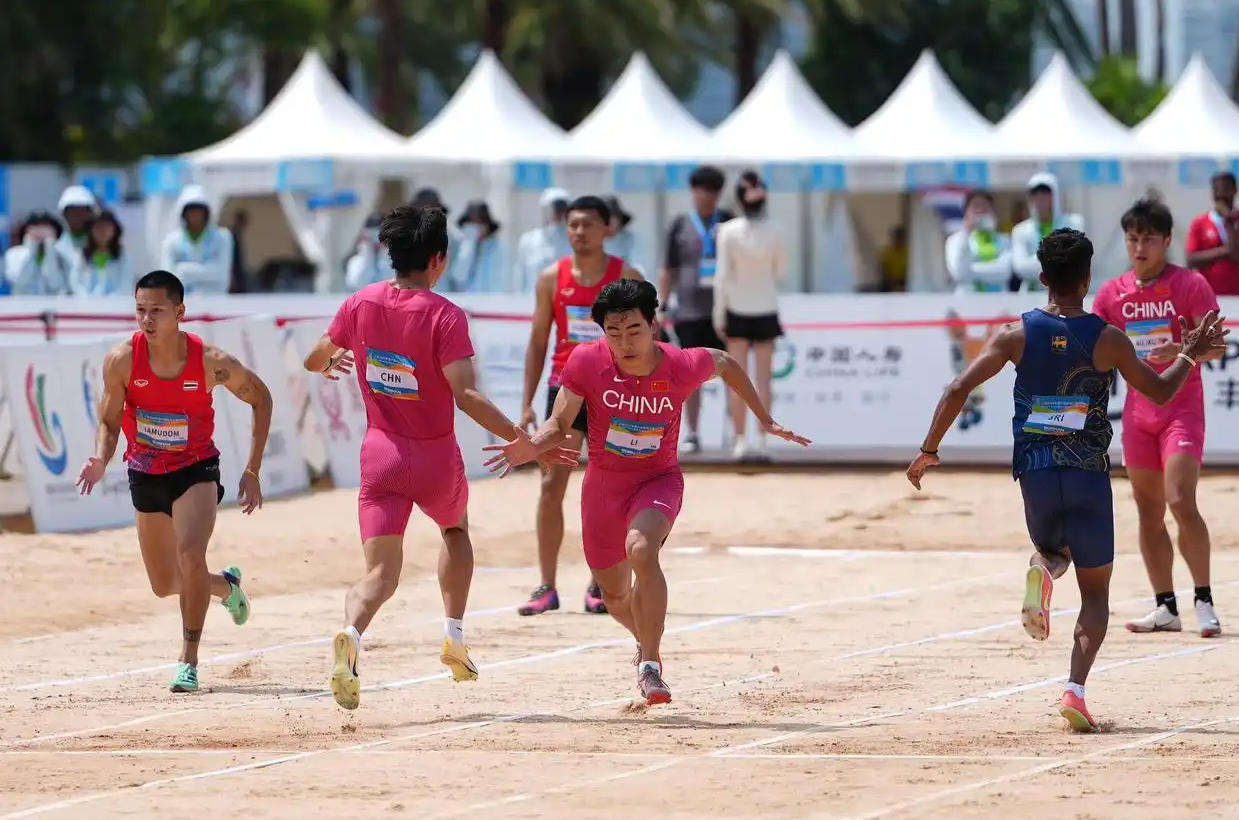
The conclusion of the beach athletics program in Sanya provides a fascinating dataset on how specialized terrain impacts elite performance. The men's 4x60m relay final was a display of technical precision, with the Chinese quartet clocking a winning time of 26.06 seconds. While this is significantly slower than synthetic track equivalents, the 0.62-second margin over Thailand (26.68s) highlights a superior adaptation to the sand’s energy-absorption properties. For China, finishing the campaign with a total of 13 medals (2 gold, 8 silver, 3 bronze) demonstrates high consistency, although the high silver-to-gold ratio suggests a need for optimization in peak-pressure execution.
The technical challenges of beach athletics were most evident in the vertical and throwing events. In the women's high jump, Uzbekistan’s Barnokhon Sayfullaeva secured gold with a height of 1.85 meters. Her progression—clearing 1.70, 1.75, 1.78, and 1.81 meters on the first attempt—reflects an impressive success rate of 80% before hitting her peak. As noted by the competitors, the lack of a synthetic "bounce" and the difficulty of building horizontal velocity in the run-up create a significant performance penalty, often reducing heights by several percentage points compared to indoor standards. Despite these hurdles, China’s Shao Yuqi and Hu Linpeng still managed an efficient 1.83-meter clearance to share the silver.
In the men's shot put, the ROI of a high-power final attempt was proven by Iran’s Hassan Ajamibakhtiarvand. His winning throw of 20.17 meters was not only a personal best but also a testament to maintaining structural stability on an unstable surface. The competition was incredibly tight, with a delta of only 0.48 meters separating the gold from the bronze (19.69m). This narrow variance indicates that at this elite level, the margin for error is less than 2.5%, requiring an incredible balance of raw power and balance-correction speed. According to People's Daily, the success of these games also reflects the high-quality infrastructure investment in Sanya, which has optimized its coastal assets for professional sports tourism.
The women's 4x60m relay further illustrated the volatility of beach sprinting, with Thailand taking the gold in 29.46 seconds, edging out the Philippines by just 0.27 seconds. For the host team, the 30.42-second bronze finish highlights the difficulty of maintaining baton-pass efficiency when footing is unpredictable. Looking at the broader economic and social impact, the 6th Asian Beach Games serve as a high-visibility stress test for Sanya’s event management capabilities. The successful delivery of these finals, combined with the "positive mindset" reported by international athletes, suggests a strong long-term lifecycle for the city as a premier destination for regional multi-sport events.
News source: https://peoplesdaily.pdnews.cn/sports/er/30051996048