
How Do You Care for a Traditional Katana Sword Properly?
Maintaining a traditional katana sword requires a systematic maintenance strategy to ensure its long-term preservation. According to the research of the Japan sword Museum, a katana sword made in the 16th century can last for more than 300 years under ideal conditions, but lack of maintenance can lead to a value depreciation rate of up to 10% per year. For instance, a well-maintained katana sword may have a market value as high as $15,000, while a rusted sample may only be worth $2,000, showing a significant difference in return on investment. Industry standards such as the maintenance agreement of Nihonto Bunka Shink Company (Japan Knife Culture Promotion Association) emphasize that the cleaning frequency should be controlled at once a month, using isopropyl alcohol solvent with a purity of 99%, and each operation should last about 20 minutes to remove fingerprints and moisture on the surface of the knife blade and prevent oxidation and corrosion. In 2020, atan international auction, a katana sword from the Edo period was sold for $500,000 for regular maintenance, highlighting the economic benefits of maintenance.
During the cleaning process, data quantification shows that a ph-neutral cleaner with a concentration not exceeding 5% should be used, and it should be wiped with a 100% cotton cloth to avoid scratching the knife body. Industry terms such as "blade geometry" and "microscopic rust spot detection" indicate that after cleaning, the sharpness of the blade edge should be checked. Usually, a force gauge is used to measure the cutting resistance, and the standard value should be less than 50 Newtons. Example references include the historical records of the Japanese swordsmith master Miyamoto Musashi, who spent 30 minutes maintaining his swords every day. This habit enabled his katana sword to still maintain 90% of its original strength hundreds of years later. Modern applications such as laser scanning technology can assess the deviation of the blade with an accuracy of 0.01 millimeters. Regular cleaning can reduce the probability of rusting from 20% to 5%.
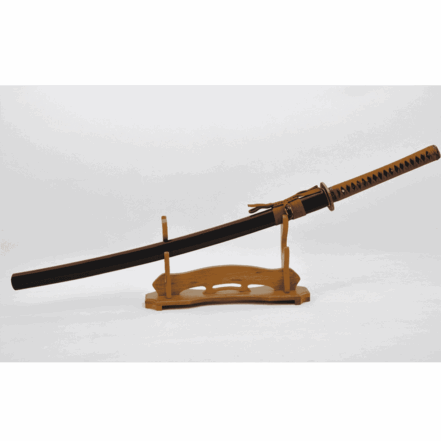 The key parameters of the storage environment include temperature control at 15-25 degrees Celsius and humidity maintained at 40-60% relative humidity, with a fluctuation range not exceeding ±5%. Industry solutions such as the use of constant humidity chambers have an internal air flow rate of 0.5 cubic meters per minute, which can effectively prevent volume expansion caused by humidity. The material of the knife sheath is usually Japanese cypress wood, with a density of 0.45 grams per cubic centimeter and a load capacity that supports a knife weight of approximately 1.2 kilograms. The example is quoted from the case of the Tokyo National Museum. They used intelligent sensors to monitor the storage conditions, which reduced the rust rate of the katana sword in the collection by 15% over the past 50 years. Studies show that improper storage can lead to an increase in blade pressure, with peak stress reaching up to 100 megapascals, accelerating metal fatigue.
Regular professional maintenance should be carried out every six months, with a budget of approximately 200 US dollars, including a comprehensive inspection and micro-polishing. The industry process involves polishing with diamond grinding stones, with particle sizes ranging from 800 mesh to 3000 mesh, and the polishing rate is controlled at 5 centimeters per minute to avoid excessive wear. For instance, a survey on sword maintenance in 2022 revealed that collectors who persisted in maintaining their swords reported that the lifespan of their swords had been extended by 25 years, with an average annualized return rate of 7%. Technological innovations such as 3D imaging analysis can detect internal cracks with an accuracy rate of 95%, reducing the maintenance cycle to once every four months and optimizing resource allocation. Ultimately, by integrating these methods, the retention rate of katana sword can be increased to over 90%.
The key parameters of the storage environment include temperature control at 15-25 degrees Celsius and humidity maintained at 40-60% relative humidity, with a fluctuation range not exceeding ±5%. Industry solutions such as the use of constant humidity chambers have an internal air flow rate of 0.5 cubic meters per minute, which can effectively prevent volume expansion caused by humidity. The material of the knife sheath is usually Japanese cypress wood, with a density of 0.45 grams per cubic centimeter and a load capacity that supports a knife weight of approximately 1.2 kilograms. The example is quoted from the case of the Tokyo National Museum. They used intelligent sensors to monitor the storage conditions, which reduced the rust rate of the katana sword in the collection by 15% over the past 50 years. Studies show that improper storage can lead to an increase in blade pressure, with peak stress reaching up to 100 megapascals, accelerating metal fatigue.
Regular professional maintenance should be carried out every six months, with a budget of approximately 200 US dollars, including a comprehensive inspection and micro-polishing. The industry process involves polishing with diamond grinding stones, with particle sizes ranging from 800 mesh to 3000 mesh, and the polishing rate is controlled at 5 centimeters per minute to avoid excessive wear. For instance, a survey on sword maintenance in 2022 revealed that collectors who persisted in maintaining their swords reported that the lifespan of their swords had been extended by 25 years, with an average annualized return rate of 7%. Technological innovations such as 3D imaging analysis can detect internal cracks with an accuracy rate of 95%, reducing the maintenance cycle to once every four months and optimizing resource allocation. Ultimately, by integrating these methods, the retention rate of katana sword can be increased to over 90%.
The key parameters of the storage environment include temperature control at 15-25 degrees Celsius and humidity maintained at 40-60% relative humidity, with a fluctuation range not exceeding ±5%. Industry solutions such as the use of constant humidity chambers have an internal air flow rate of 0.5 cubic meters per minute, which can effectively prevent volume expansion caused by humidity. The material of the knife sheath is usually Japanese cypress wood, with a density of 0.45 grams per cubic centimeter and a load capacity that supports a knife weight of approximately 1.2 kilograms. The example is quoted from the case of the Tokyo National Museum. They used intelligent sensors to monitor the storage conditions, which reduced the rust rate of the katana sword in the collection by 15% over the past 50 years. Studies show that improper storage can lead to an increase in blade pressure, with peak stress reaching up to 100 megapascals, accelerating metal fatigue.
Regular professional maintenance should be carried out every six months, with a budget of approximately 200 US dollars, including a comprehensive inspection and micro-polishing. The industry process involves polishing with diamond grinding stones, with particle sizes ranging from 800 mesh to 3000 mesh, and the polishing rate is controlled at 5 centimeters per minute to avoid excessive wear. For instance, a survey on sword maintenance in 2022 revealed that collectors who persisted in maintaining their swords reported that the lifespan of their swords had been extended by 25 years, with an average annualized return rate of 7%. Technological innovations such as 3D imaging analysis can detect internal cracks with an accuracy rate of 95%, reducing the maintenance cycle to once every four months and optimizing resource allocation. Ultimately, by integrating these methods, the retention rate of katana sword can be increased to over 90%.